
Crypto Risk Management Strategies:
Crypto offers some remarkable opportunities, but it comes with real risk attached. The same volatility that can make you money can also wipe out an unprotected account in a matter of hours. The traders who last aren’t the ones who win every trade. They’re the ones who use solid crypto risk management strategies to keep their capital safe when the market turns against them.
Without a clear risk plan, trading is really just gambling with extra steps. In this guide to crypto risk management strategies, we’ll go through the core ideas behind preserving your capital, the models for sizing your positions, the safeguards you can build into every trade, and the mental habits you need to handle digital asset markets safely.
Why Risk Management Is Crucial in Crypto Trading
Crypto never closes. It runs 24/7, and there are no circuit breakers or trading halts to slow things down when panic sets in. A piece of news, a large whale transaction, or a sudden wave of liquidations can send prices swinging wildly within minutes.
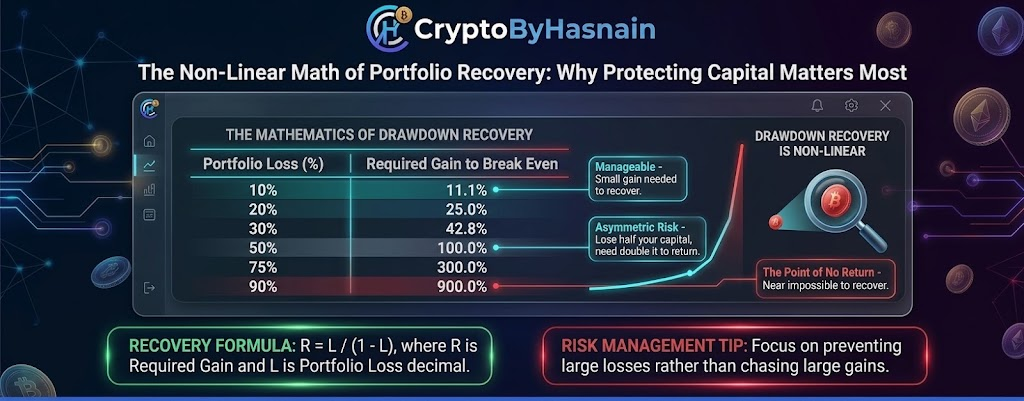
As the numbers above show, losses hit much harder than gains help. If you lose 50% of your account, you need a 100% gain just to get back to where you started. That’s why protecting your downside matters far more, statistically, than chasing big speculative wins.
Core Pillars of Crypto Risk Management Strategies
To build a trading framework that holds up under pressure, base your approach on four basic pillars:
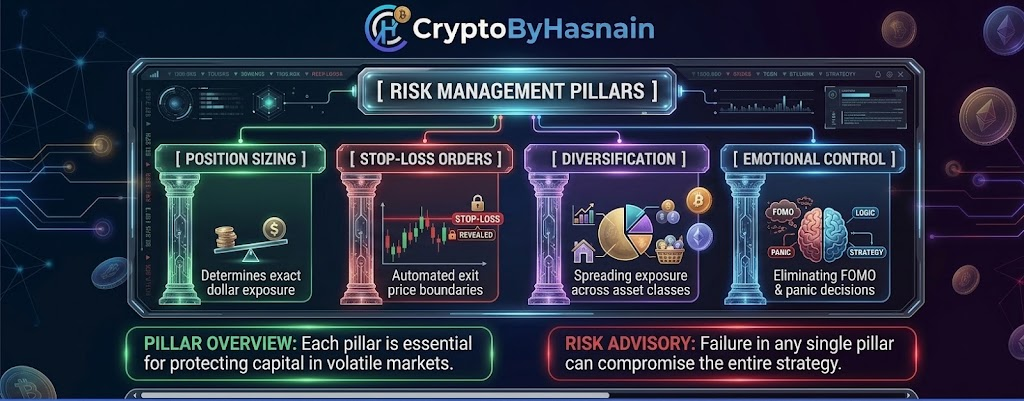
1. The 1% to 2% Rule and Position Sizing
The foundation of protecting your capital is deciding how much of it you’re willing to put at risk on any single trade.
What Is the 1% Rule?
The 1% rule says you should never risk more than 1% of your total account equity on one position. Say your trading portfolio is $10,000. The most you should be willing to lose on a trade is $100.
Calculating Exact Position Size
A lot of beginners mix up position size and risk amount, but they aren’t the same thing. Your position size is the full dollar value of the trade. Your risk is only the amount you’d lose if your stop-loss gets triggered. This is one of the most practical crypto risk management strategies you can learn, because it turns a vague rule into an exact number.
Formula for position size: $$\text{Position Size} = \frac{\text{Total Capital} \times \text{Risk Percentage}}{\text{Entry Price} – \text{Stop-Loss Price}}$$
Example walkthrough:
- Total account capital: $5,000
- Risk tolerance: 2% ($100 maximum loss)
- Bitcoin entry price: $60,000
- Stop-loss price: $57,000 (a 5% drop from entry)
$$\text{Position Size} = \frac{\$100}{\$60,000 – \$57,000} = \frac{\$100}{\$3,000} = 0.0333 \text{ BTC}$$
In this setup, you buy 0.0333 BTC, which is worth about $2,000. The trade looks big at $2,000, but if the market hits your stop-loss, you lose exactly $100 and no more.
2. Master the Use of Stop-Loss Orders
A stop-loss order is an automatic instruction you give your exchange to close a trade once the price reaches a level you’ve picked. Think of it as an emergency brake. It makes sure one bad trade can’t take down your whole account.
Types of Stop-Loss Orders
- Fixed stop-loss: You place it at a set price based on key chart levels, for example just below a major support level or a recent low.
- Trailing stop-loss: It follows the price upward as your trade moves into profit. If the market reverses, the trailing stop locks in the gains you’ve made while still limiting how much you can lose.
- Time-based stop-loss: It closes a position if the trade hasn’t moved the way you expected within a set amount of time, which frees up your capital for better opportunities.
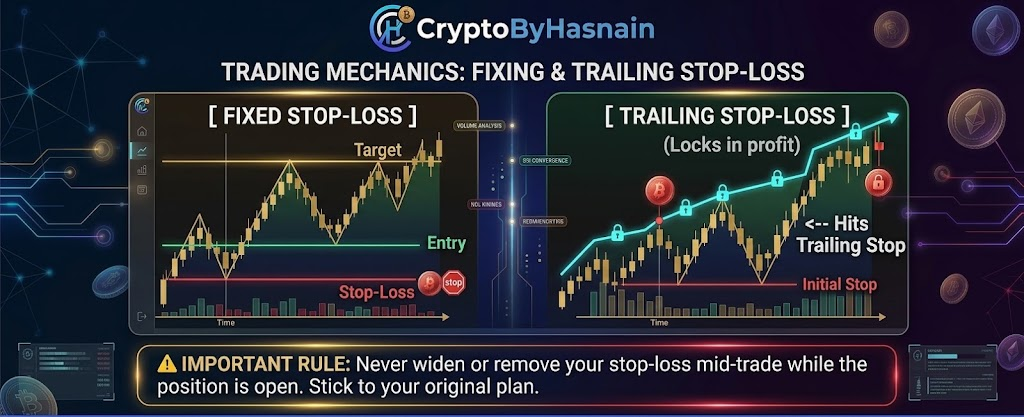
Important Rule: Never widen or remove your stop-loss mid-trade while the market moves against you. Accepting small, controlled losses is part of standard trading operations.
3. Risk-to-Reward Ratio (RRR)
The Risk-to-Reward Ratio (RRR) measures the potential risk of a trade relative to its expected potential payout.
- 1:1 RRR: Risking $100 to make $100.
- 1:2 RRR: Risking $100 to make $200.
- 1:3 RRR: Risking $100 to make $300.
Why RRR Matters for Long-Term Profitability
Using a favorable Risk-to-Reward ratio allows you to maintain overall profitability even if your win rate is below 50%.
| Win Rate | Average Risk | Average Reward | Total Trades | Wins | Losses | Net Profit / Loss |
| 40% | $100 | $300 (1:3 RRR) | 10 | 4 ($1,200) | 6 (-$600) | +$600 Profit |
| 60% | $100 | $100 (1:1 RRR) | 10 | 6 ($600) | 4 (-$400) | +$200 Profit |
As demonstrated in the table, a trader with only a 40% win rate using a 1:3 RRR yields three times more net profit than a trader winning 60% of trades with a 1:1 RRR.
4. Portfolio Diversification Strategy
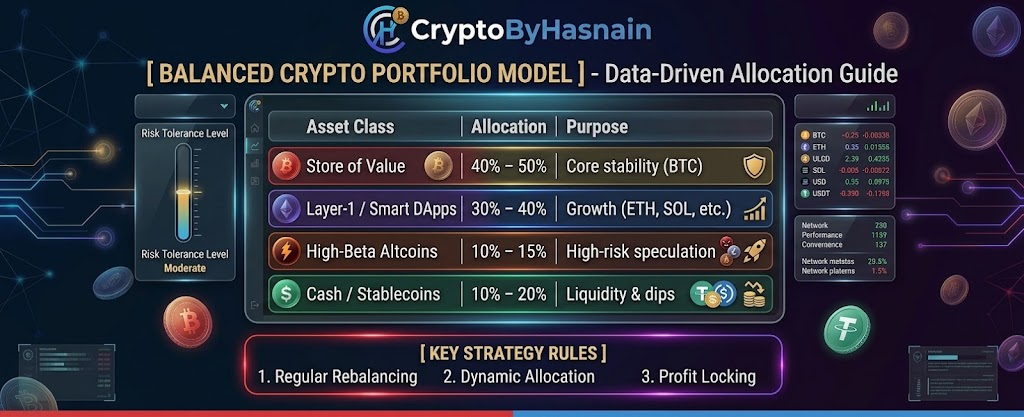
“Don’t put all your eggs in one basket” is a critical rule in crypto trading. Concentrating your capital into a single altcoin exposes you to project-specific risks, such as smart contract exploits, team abandons, or sudden regulatory actions.
Key Diversification Guidelines
- Keep a stablecoin reserve: Hold 10% to 20% of your portfolio in cash or stablecoins such as USDT or USDC. That gives you room to buy when the whole market drops.
- Avoid over-correlation: Owning ten different meme coins or AI tokens isn’t real diversification. Most altcoins in the same sector move together almost in lockstep. Spread your risk across different blockchain ecosystems and different use cases instead.
5. Managing Leverage and Margin Risks
Leverage lets you borrow money from an exchange so you can open a bigger position than your own balance would allow, for example 5x, 10x, or even 50x.
- The trap of leverage: It multiplies your profits on winning trades, but it multiplies your losses at exactly the same rate.
- Liquidation risk: Exchanges require a minimum maintenance margin on leveraged trades. If the price moves against you past a certain point, the exchange closes your trade by force. That’s called liquidation, and you lose all of the margin you put up.
Best practice for beginners: Stick to spot trading while you’re learning. Stay away from leveraged futures and margin trading until you’ve shown consistent profits on the spot market for at least 6 to 12 months.
6. Psychology and Emotional Risk Management
A trader’s worst enemy is rarely the chart. It’s usually their own impulses. Greed, fear, and impatience push people into inconsistent decisions, and that’s a major reason why crypto risk management strategies matter so much.
Overcoming FOMO and Revenge Trading
- FOMO (Fear of Missing Out): Chasing a green candle after an asset has already jumped 30% or 50% often means buying close to a local top. Be patient and wait for a healthy pullback or a fresh, well-defined setup.
- Revenge trading: Trying to win back what you just lost by jumping into a new trade without any analysis. It usually just piles more losses on top of the first one.
- Trading journal: Write down every trade you take, including the entry and exit prices, your position size, your RRR, and the reasons you took it. When you look back over your journal from time to time, you’ll start to notice the emotional mistakes you keep repeating.
Step-by-Step Risk Checklist Before Every Trade
Before you press “Buy” or “Sell,” run through this last checklist:
- Is the macro trend clear? Are you trading with the main trend, or trying to catch a falling knife?
- Where is your stop-loss? Does it sit at a logical spot on the chart, or did you just pick a random number?
- Have you calculated your position size? If your stop-loss gets hit, will the loss be 1% to 2% of your capital or less?
- Is your risk-to-reward ratio at least 1:2? Does the profit target offer at least twice as much as you’re risking?
- Are you emotionally calm? Are you following a planned setup, or reacting to a recent loss or to market noise?
Conclusion
Good crypto risk management strategies are what turn speculative trading into something you can sustain for the long run, almost like a business. Markets will always deliver surprise volatility, black swan events, and sudden changes in trend. You can’t control what the market does next, but you can always control how much capital you put at risk.
When you automate your stop-loss orders, calculate your exact position size, keep your risk-to-reward ratios realistic, and keep your emotions in check, you protect your trading capital from market shocks and set yourself up for steady success over time.
Disclaimer: Content published on Cryptobyhasnain is for informational and educational purposes only and should not be construed as financial advice. Always do your own research before making any investment decisions.