

Date: September 29, 2026
Buying Bitcoin or another coin has never been easier. Figuring out what you owe when you sell, swap, move, or earn it is another story. Plenty of people can set up an exchange account in ten minutes but have no idea what happens tax-wise once they start trading.
That’s where a crypto tax strategy for beginners comes in.
You don’t have to be a tax expert to build one. What matters most is knowing which crypto activities can trigger reporting duties, keeping clean records, and getting your numbers in order well before you file.
This guide walks you through it one step at a time. You’ll learn how to organize your transactions, work out gains and losses, spot taxable events, track your cost basis, and dodge the reporting mistakes that trip up newcomers.
Quick heads-up: Crypto tax rules differ a lot from one country to the next, and they change over time. This article is general education, not personal tax, legal, or financial advice. Check the rules where you live, or talk to a qualified tax professional, before you file.
What Is a Crypto Tax Strategy for Beginners?
A crypto tax strategy for beginners is just a practical system for tracking and reporting the income, gains, and losses that come from your crypto activity.
“Strategy” sounds fancier than it is. Really, you’re trying to answer a handful of plain questions:
- What crypto did you buy?
- When did you buy it?
- What did it cost you?
- What fees did you pay?
- Did you sell it or swap it?
- What did you get in return?
- Did you earn any crypto through work, staking, mining, or something similar?
- Can you prove all of this with records?
If you can’t answer those, working out your tax position gets painful fast.
The best habit is to treat crypto like any other financial record. Keep things tidy all year long, so you’re not digging through old emails and exchange exports at the last minute trying to rebuild your history.
Step 1: Know Which Crypto Activities May Matter for Taxes
The first thing to grasp in any crypto tax strategy for beginners is that owning crypto and getting rid of it are usually treated differently.
Buying a coin and letting it sit there often isn’t the same kind of tax event as selling it for cash.
Depending on where you live, activities that could be reportable include:
- Selling crypto for cash
- Trading one cryptocurrency for another
- Spending crypto on goods or services
- Getting paid in crypto
- Mining
- Earning staking rewards
- Receiving certain airdrops or promotional rewards
- Getting crypto for freelance or business work
- Other forms of crypto-related income
The exact treatment depends on your country and on what the transaction actually was.
Picture two people. One buys Bitcoin and sits on it for months. The other sells and swaps constantly. Their tax situations can look very different.
That’s why the difference between holding crypto and disposing of crypto is the best place to start.
Step 2: Build a Complete Crypto Transaction List
Before you calculate anything, gather your history.
This is one of the most important parts of any crypto tax strategy for beginners, and it’s the part people most often skip.
Most crypto users don’t keep everything in one place. You might have used:
- A centralized exchange
- A separate software wallet
- A hardware wallet
- A decentralized exchange
- A payment app
- A staking platform
- A crypto debit card
- Several blockchain addresses
If you only download the history from one exchange, you’ll end up with an incomplete picture.
Start by writing down every platform and wallet you’ve ever touched. Then, for each account, try to collect:
- Transaction date
- Name of the cryptocurrency
- Amount
- Purchase price
- Sale price
- Transaction fees
- The wallet or exchange involved
- Type of transaction
- Transaction ID or hash, if there is one
If you can, don’t wait until year-end. A little bookkeeping each month saves a lot of stress later.
Step 3: Work Out Your Cost Basis
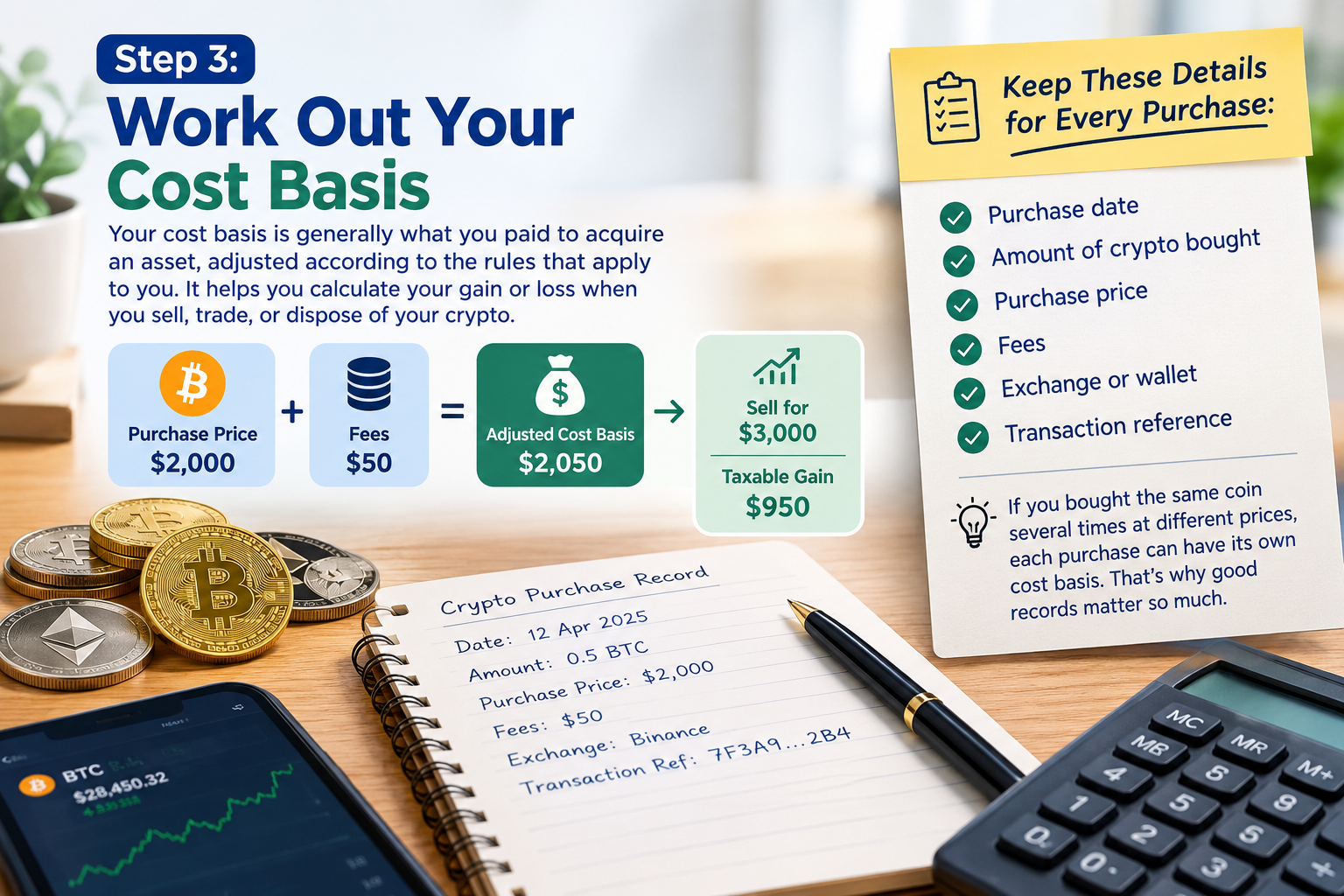
Cost basis is one of the biggest ideas in crypto taxes, so it’s worth getting comfortable with it early.
Put simply, your cost basis is generally what you paid to acquire an asset, adjusted according to whatever rules apply to you.
Say you bought crypto for $2,000 and paid $50 in fees. Depending on your local rules, those fees might count toward your basis.
Later you dispose of that crypto for $3,000. Your taxable gain is typically based on the gap between your proceeds and your adjusted cost basis.
The takeaway: don’t just look at how much money landed in your bank account. You have to know what you originally paid, too.
Keep these details for every purchase:
- Purchase date
- Amount of crypto bought
- Purchase price
- Fees
- Exchange or wallet
- Transaction reference
If you bought the same coin several times at different prices, each purchase can carry its own cost basis. This is exactly why good records matter so much.
Step 4: Keep Crypto Income Apart From Investment Activity
Not everything in your crypto account counts as an investment gain. Sometimes crypto is simply income.
You might receive it for:
- Freelance work
- Consulting
- Employment
- Mining
- Staking
- Business activity
- Certain rewards
Tax authorities may treat these very differently from an investment sale.
Take freelance work. If a client pays you in crypto, the rules in your country may treat the value of that crypto on the day you received it as income. If you later sell it for more or less than that value, you may also have a separate gain or loss to work out.
This is why a good crypto tax strategy for beginners splits income from investing. Set up separate categories in your records.
Category A: Investment activity
Examples:
- Buying crypto
- Selling crypto
- Swapping crypto
- Holding crypto
Category B: Crypto income
Examples:
- Freelance payments
- Mining income
- Staking rewards
- Business payments
- Other crypto compensation
Keeping the two apart makes your records far easier to read, and far easier to hand to an accountant.
Step 5: Track Your Crypto-to-Crypto Swaps
A very common beginner mistake is thinking taxes only matter when crypto is turned back into regular money.
That may not be true.
In many tax systems, trading one cryptocurrency for another can have tax consequences.
Here’s an example. You buy Ethereum, then later swap it for Bitcoin. You never received dollars or any other traditional currency, but under your local rules that swap could still count as a disposal of the Ethereum.
So log your crypto-to-crypto trades as carefully as your cash sales. For each swap, write down:
- The coin you gave up
- How much of it
- The coin you received
- Its value at the time of the trade
- Fees
- The date and time
- The exchange or platform
When it’s time to calculate gains and losses, you’ll be glad you have this.
Step 6: Don’t Ignore Crypto Fees
Fees look tiny when you’re making trades, but they pile up quickly.
They can come from:
- Exchange trading fees
- Blockchain network fees
- Withdrawal fees
- Deposit fees
- Other transaction-related charges
How a fee affects your tax calculation depends on the kind of transaction and the rules where you live. So don’t strip fees out of your records.
Keep them documented. If you buy $5,000 worth of crypto and pay a $50 fee, your records should show both numbers.
A detailed history gives you, and any tax professional you hire, the information needed to decide how each fee should be treated.
Step 7: Calculate Your Gains and Losses
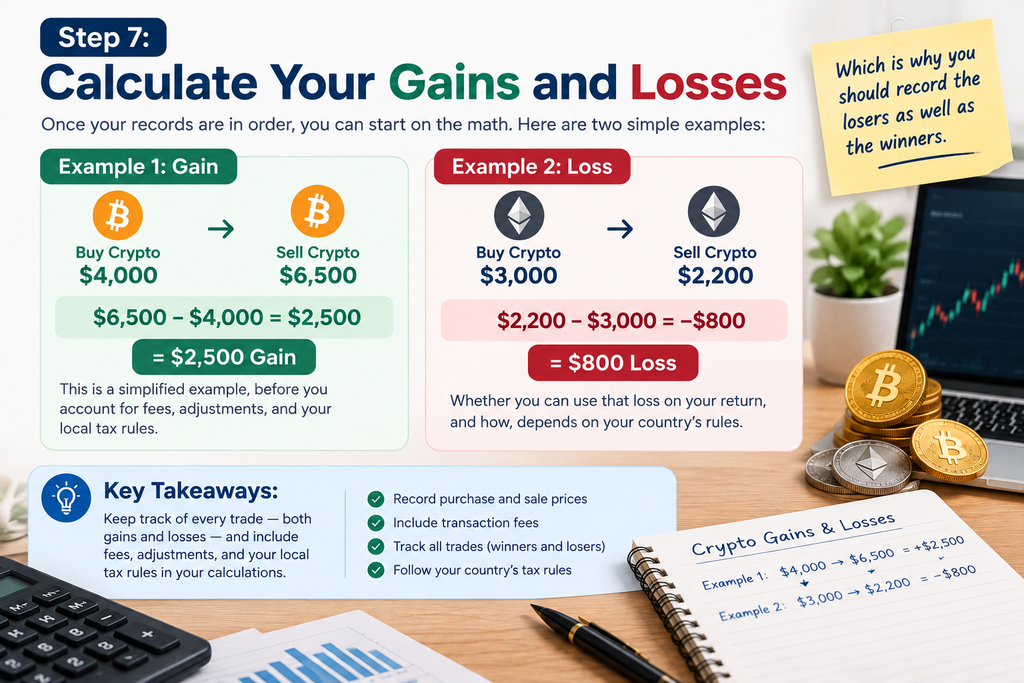
Once your records are in order, you can start on the math.
Here’s a simple example. You buy crypto for $4,000 and later sell it for $6,500.
$6,500 − $4,000 = $2,500
That’s a $2,500 gain in this simplified case, before you account for fees, adjustments, and your local tax rules.
Now try another. You buy crypto for $3,000 and sell it later for $2,200.
$2,200 − $3,000 = −$800
That’s an $800 loss. Whether you can use that loss on your return, and how, depends on your country’s rules.
Which is why you should record the losers as well as the winners. Keeping only your profitable trades gives you a lopsided picture.
Step 8: Understand Why Your Holding Period Can Matter
In some places, how long you held an investment changes how the gain or loss is treated.
Some tax systems, for example, separate short-term activity from long-term activity. That makes your purchase date just as important as your sale date.
Say you bought an asset on January 10 and sold it on August 15. Keep both dates. If you bought a different asset on the same January 10 but sold it much later, the tax treatment could be different.
Don’t trust your memory here. Your exchange history, wallet records, and transaction documents should pin down the dates for you.
Step 9: Be Careful When Moving Crypto Between Your Own Wallets
Sending crypto from one wallet you own to another wallet you also control isn’t necessarily the same as selling it.
Say you move Bitcoin from an exchange to your personal hardware wallet. It’s still your Bitcoin. Even so, write the transfer down, so you don’t later mistake those coins for a brand-new purchase.
This gets especially important once you use more than one wallet. Your records should be able to tell you:
Where did this crypto come from?
When did I get it?
What did I pay for it?
Was it just moved between my own accounts?
Clear answers help you avoid double-reporting and a lot of confusion.
Step 10: Review Staking, Mining, and Rewards
Trading isn’t the only way to end up with crypto. Some people earn it through staking, mining, reward programs, and other activities.
These deserve extra attention, because the tax treatment can depend on the exact activity and on local regulations.
If you receive staking rewards, for instance, you may want to record:
- The date received
- The amount received
- The cryptocurrency
- Its fair market value, or whatever valuation applies
- The platform
- The transaction reference
Do the same for mining and any other crypto income.
And don’t assume rewards are tax-free just because you haven’t sold them. The right treatment depends on the tax laws that apply to you.
Step 11: Use a Crypto Tax Spreadsheet
For most beginners, a plain spreadsheet does the job well.
You could set up columns like these:
| Date | Asset | Transaction | Amount | Cost | Proceeds | Fees | Gain/Loss |
|---|---|---|---|---|---|---|---|
| Jan 10 | Bitcoin | Buy | 0.05 BTC | $2,000 | — | $20 | — |
| Apr 15 | Bitcoin | Sell | 0.02 BTC | — | $1,000 | $10 | Calculate |
Fill in a row every time something happens, and total it all up at the end of the year. A simple sheet you actually keep updated beats a fancy tool you abandon after two weeks.
Final Thoughts
A solid crypto tax strategy for beginners doesn’t need to be complicated. Know which activities might matter, collect every transaction, track your cost basis and fees, separate income from investing, and keep your records current. Do those things and tax season gets a lot less stressful.
Since the rules vary so much by country, it’s smart to confirm the details with a qualified tax professional before you file.