Date: September 30, 2026
Buying crypto can take less than a minute.
Understanding what you just bought can take a lot longer.
That gap matters.
A coin can be all over social media, all over YouTube, and on the lips of thousands of people online without being a good fit for your goals. Crypto markets can also swing wildly, and regulators have warned again and again that investors can run into heavy losses, fraud, hacking, liquidity trouble, and other risks.
That’s why learning how to research crypto before investing is one of the most useful skills a beginner can pick up.
You don’t have to understand every line of blockchain code. You don’t need a finance degree. And you definitely don’t need to burn twelve hours on every new token that pops up online.
What you need is a process you can repeat.
Before your money goes into any cryptocurrency, you should have a fair grasp of what the project does, why its token exists, how the supply works, who’s building it, what could go wrong, and whether the information you’re reading can be checked.
This guide walks you through that process one step at a time.
Important: This article is for educational purposes only and isn’t personal financial or investment advice. Crypto assets can be highly speculative and volatile, and rules and protections differ from country to country. Never invest money you can’t afford to lose.
What Does It Mean to Research a Cryptocurrency?
Many beginners hear “research a crypto project” and picture checking today’s price and deciding whether the chart looks nice.
That’s a tiny slice of the job.
Real research means asking questions like these:
- What problem is this project trying to solve?
- Does it actually solve it?
- What does the token do?
- Who’s building the project?
- Can you identify the team?
- How many tokens exist?
- How many could exist down the road?
- Who owns the supply?
- Where does the demand come from?
- Does the technology work?
- Is there a live product?
- Who are the competitors?
- What could make the project fail?
- Where is your information coming from?
The point isn’t to predict the future perfectly. Nobody can.
The point is to base your decision on something more solid than hype, a green candle, or a random post on social media.
That’s the foundation of how to research crypto before investing.
Step 1: Start With the Basic Idea
Before you look at a single price prediction, get clear on the idea behind the coin.
Ask one plain question:
“What is this project actually trying to do?”
If you’ve done your reading and still can’t explain it in simple words, you probably need to learn more before you consider putting money in.
A project might focus on:
- Payments
- Decentralized finance
- Smart contracts
- Gaming
- Data storage
- Tokenized assets
- Blockchain infrastructure
- Privacy
- Decentralized apps
- Digital identity
The category doesn’t make a project good or bad.
What counts is whether the project has a clear purpose, and whether its technology is genuinely useful for that purpose.
Investor.gov advises people to understand the technology behind a digital asset, along with the risks, before committing money.
So begin with the basics.
Don’t start with:
“How high can this coin go?”
Start with:
“What exactly am I buying?”
Step 2: Read the Official Website Carefully
The official website is usually the first stop.
But don’t stop at the homepage.
Look for sections like:
- About
- Documentation
- Whitepaper
- Technology
- Roadmap
- Tokenomics
- Team
- Governance
- Developers
- Security
- Audits
- Community
- Legal information
Homepages are built to grab attention. The documentation is where the more useful details tend to hide.
Pay attention to the wording, too.
Does the project explain plainly what it does?
Or is the site packed with phrases like:
- Revolutionary
- Guaranteed
- Next-generation wealth
- Massive returns
- Risk-free
- The next Bitcoin
- Guaranteed passive income
Marketing language isn’t evidence.
And a slick, professional site doesn’t prove a project is legitimate.
Investor.gov warns that fraudulent crypto schemes can use polished websites, fake testimonials, unrealistic returns, and other tricks to look trustworthy.
So treat the website as a starting point, not the final word.
Step 3: Read the Whitepaper
A whitepaper can give you a much deeper view of a crypto project.
You don’t have to follow every technical detail. Just look for answers to a few basic questions.
What problem is the project solving?
Good research starts with the problem.
If the project can’t clearly explain the problem it’s tackling, dig further.
How does the technology work?
You don’t need to become a blockchain developer, but you should understand the basic mechanism.
Why is blockchain necessary?
Many beginners never ask this one.
If a project says it solves a problem with blockchain, ask:
“What does blockchain add here?”
What role does the token play?
This may be the most important question of all.
A project can have impressive technology and still have a token with no real economic role.
Step 4: Understand What the Token Actually Does
A cryptocurrency and the project behind it aren’t always the same thing.
A project may include:
- A blockchain
- An application
- A company or development organization
- A token
- Governance mechanisms
- Other digital assets
You need to see how these pieces relate.
Ask:
Why does this token need to exist?
Its job might be:
- Paying transaction fees
- Governance
- Accessing a service
- Staking
- Securing the network
- Serving as collateral
- Paying out rewards
- Providing utility inside an app
Be careful, though.
A token having a use case doesn’t guarantee its value will rise.
A token can have a function and still be a poor investment.
That difference is easy to miss.
Step 5: Study Tokenomics
If you want to know how to research crypto before investing, you can’t skip tokenomics.
Tokenomics is the economic structure built around a token.
Some of the numbers that matter most:
Circulating supply
How many tokens are available on the market right now?
Maximum supply
Is there a cap on how many tokens can ever exist?
Total supply
How many tokens have been created, including ones that aren’t circulating yet?
Market capitalization
Market cap is usually calculated from the token’s price and its circulating supply.
For example:
Token price × circulating supply = approximate market capitalization
This matters because a low price per token doesn’t make a cryptocurrency cheap.
Picture this:
- Coin A costs $0.10
- Coin B costs $500
Those prices alone tell you almost nothing.
If Coin A has a gigantic supply, its total market value could still be enormous.
That’s why looking only at the price per coin can mislead you.
Step 6: Look for Future Token Unlocks
Beginners miss this one all the time.
Some projects launch with only part of their total supply in circulation.
The rest gets released over time.
Those releases can be tied to:
- Team allocations
- Investor allocations
- Ecosystem rewards
- Treasury funds
- Development incentives
- Community programs
So ask:
“How much more supply could hit the market?”
And:
“When are those tokens scheduled to unlock?”
More supply doesn’t automatically mean the price has to drop. Markets are messier than that.
Still, knowing what’s coming helps you see the economic picture.
When you research a project, look for an official token allocation schedule and, where you can, compare it with independent data.
Step 7: Find Out Who Owns the Tokens
How tokens are distributed can tell you a lot.
If a handful of wallets control a big share of the circulating supply, that’s concentration risk.
Ask:
- How much does the team hold?
- How much do early investors hold?
- How much belongs to the community?
- How much is set aside for the treasury?
- Are there any very large wallets?
- Are allocations locked up?
- When do those locks end?
Big holders don’t automatically mean something is wrong.
But concentration can shape how a market behaves and how governance plays out.
It’s one more thing to understand before you decide.
Step 8: Research the Team
The people building a project are a major piece of the puzzle.
Look for:
- Names
- Past experience
- Technical background
- Previous projects
- Public professional profiles
- Development history
Also find out whether the team is anonymous.
Anonymous doesn’t automatically mean fraudulent. Some legitimate crypto projects have been built by pseudonymous contributors.
But anonymity makes verification harder.
So rather than writing off an anonymous project, just recognize that you’ll have less information to go on.
The same goes for partnership claims.
If a project announces:
“We’re partnered with a major company.”
Don’t stop at the announcement.
Where you can, look for confirmation from the other company.
Step 9: Check Whether There’s a Real Product
One of the quickest ways to tell research from hype is to look for something that actually works.
Ask:
Can I use the product?
Depending on the project, you may be able to:
- Use an application
- Explore the blockchain
- Test a protocol
- Review developer activity
- Look at transactions
- Interact with a public network
- Read technical documentation
A project that has promised a product “soon” for years deserves extra scrutiny.
A working product isn’t a guarantee of investment success, either.
But it gives you something concrete to examine.
Step 10: Look at Developer Activity
For tech-focused projects, development activity can tell you something.
Check public repositories or other signs of ongoing work where they’re available.
Some questions to ask:
- Is development active?
- Are developers contributing regularly?
- Are issues getting fixed?
- Are updates being released?
- Is the code public?
- Has the project been maintained over time?
Don’t judge a project by GitHub commits alone.
More commits don’t necessarily mean better technology.
A small, experienced team may never produce thousands of visible commits.
Treat development activity as one piece of a bigger picture.
Step 11: Investigate Security and Audits
Crypto projects can involve smart contracts, bridges, wallets, decentralized apps, and other technical systems.
Any of these can have vulnerabilities.
If a project has had a security audit, find out:
- Who did the audit?
- When was it finished?
- What was actually audited?
- Were problems found?
- Were they fixed?
- Is the audit public?
Don’t read the word “audited” as a promise of safety.
An audit isn’t an insurance policy.
It doesn’t mean the project can’t be hacked.
It’s simply one more piece of information about how the project was reviewed.
Security stays a big deal in crypto, because regulators list hacking, malware, technical failures, fraud, and platform collapses among the risks of crypto assets.
Step 12: Research the Community Without Blindly Trusting It
Crypto communities are busy places.
You’ll find discussions on:
- X
- Discord
- Telegram
- YouTube
- Forums
- Project community pages
They can surface questions and problems you’d never have thought of.
But there’s a big difference between researching a community and believing a community.
Someone might write:
“This coin is guaranteed to hit $10.”
That’s a prediction, not evidence.
Someone else might say:
“The developers are building something incredible.”
Again, that’s an opinion.
Use social media to find leads.
Then check the important claims against primary sources or independent evidence.
Investor.gov warns that social media is often used to push crypto scams, and that fake testimonials and celebrity endorsements can make a scheme look legitimate.
Step 13: Be Careful With Influencers
This one gets its own section because so many beginners first hear about crypto projects from influencers.
A YouTuber might say:
“This could be the next 100x coin.”
An influencer might post:
“I’m extremely bullish on this project.”
A celebrity might push a crypto opportunity.
None of that shows the asset is right for you.
Investor.gov specifically warns that a celebrity endorsement doesn’t make a crypto investment legitimate or appropriate, and that celebrities may be paid to promote things.
That doesn’t make every influencer dishonest.
It means you should keep two things separate:
Promotion
and
Evidence.
When someone recommends a coin, ask:
“What evidence backs up that claim?”
Then do your own digging.
Step 14: Check Liquidity and Trading Activity
Imagine you buy a cryptocurrency and later find out almost nobody wants to buy it from you.
That’s a real problem.
Liquidity is, broadly, how easily you can buy or sell an asset without moving its price much.
When you research a coin, look at:
- Trading volume
- Major trading venues
- Bid and ask spreads
- Market depth, where available
- The number of active markets
A small token with thin liquidity can behave very differently from a large, heavily traded asset.
Investor.gov notes that crypto markets can involve volatility and illiquidity, and both can raise your investment risk.
Don’t assume a token will be easy to sell just because you managed to buy it.
Step 15: Research Where the Crypto Is Available
Before you buy, find out where a coin can actually be traded.
You might find it on:
- Centralized exchanges
- Decentralized exchanges
- Specialized platforms
- Regional exchanges
Availability can change.
Being listed on a platform doesn’t make a token safe.
And not being listed on a major exchange doesn’t make it a fraud.
The goal is just to understand the market setup around the asset.
Also check whether the platform is available to you, and legal to use, where you live.
Step 16: Look for Red Flags
Knowing what to investigate is helpful.
Knowing what should make you pause is just as important.
Some warning signs:
Guaranteed profits
Promises of guaranteed high returns should make you cautious right away.
Investor.gov calls guaranteed high returns with little or no risk a classic sign of investment fraud.
Pressure to act immediately
Lines like:
“Buy today or you’ll miss everything.”
are often designed to stop you from doing careful research.
Anonymous claims with no evidence
Be wary when important claims can’t be verified.
Fake-looking partnerships
If a project says it works with a major organization, look for confirmation from that organization itself.
Unclear tokenomics
If you can’t work out the supply, the allocations, or the unlock schedule, slow down.
No working product
A project that keeps promising future development needs a closer look.
Unrealistic returns
If someone says you can make enormous returns with hardly any risk, treat that as a major red flag.
Requests to send crypto directly
Be especially careful if anyone asks you to send crypto to a personal wallet in exchange for promised returns.
Step 17: Understand the Difference Between Price and Value
This is one of the most important lessons for beginners.
A coin priced at $0.01 isn’t automatically cheaper than one priced at $1,000.
The number on your screen is just the price of a single unit.
You have to consider total supply and market cap.
Here’s an example:
Token A
Price: $0.10
Supply: 100 billion
Approximate market capitalization:
$10 billion
Token B
Price: $100
Supply: 10 million
Approximate market capitalization:
$1 billion
Token B has a much higher price per coin, but in this simplified example its overall market value is lower.
That’s why:
“It’s only 10 cents, so it has more room to grow.”
isn’t a strong research argument on its own.
Step 18: Think About Your Own Risk Before Buying
Research shouldn’t stop at the project. You need to look at yourself, too.
Ask:
- How much money can I afford to lose?
- When might I need this money?
- How do I handle big price swings?
- Am I using borrowed money?
- Do I have an emergency fund?
- Am I buying because I understand the project, or because everyone else is talking about it?
Investor.gov stresses that goals, time horizon, risk tolerance, and diversification all matter when you evaluate investments.
A cryptocurrency can be interesting and still be wrong for you.
That distinction matters.
Step 19: Don’t Invest Just Because You’re Afraid of Missing Out
FOMO, the fear of missing out, is powerful in crypto.
You see a coin jump 30%, 50%, or more, and suddenly it feels like you have to buy right now.
But a price spike doesn’t cancel the need for research.
If anything, a sudden surge is a reason to slow down.
Ask:
What changed?
Was it:
- A product launch?
- A protocol upgrade?
- New adoption?
- A partnership?
- A major market development?
- Or just more speculation?
Investor.gov has warned that fraudsters exploit FOMO to push people into rushed decisions about digital assets.
You don’t have to buy every asset that’s climbing.
Another opportunity will always come along.
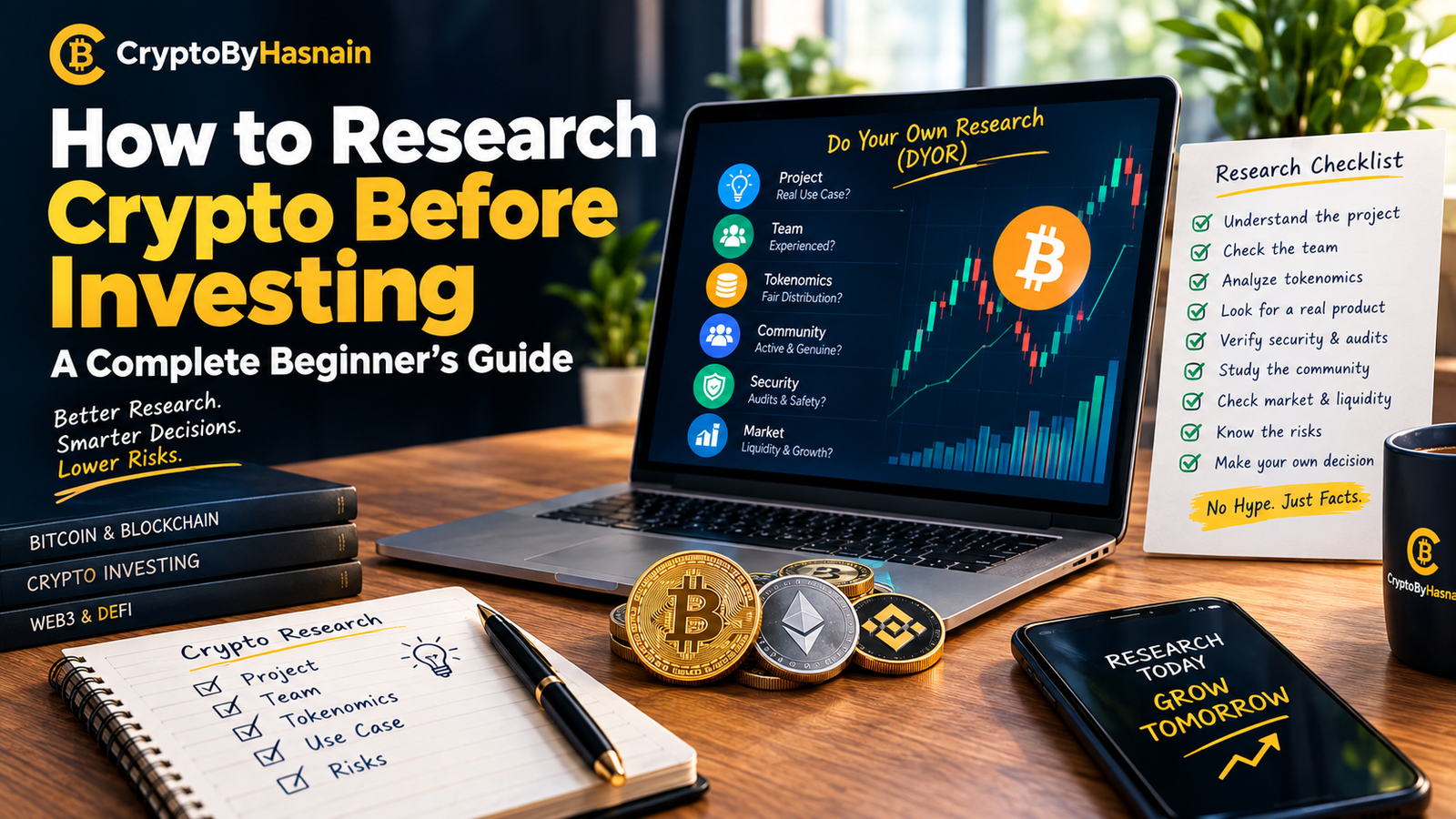
Step 20: Create Your Own Crypto Research Checklist
Once you understand the process, turn it into a checklist.
Before you research a new coin, write down:
Project
- What does it do?
- What problem does it solve?
- Who is it for?
Technology
- How does it work?
- Is the technology public?
- Is there a working product?
Token
- Why does the token exist?
- What is it used for?
- Is it actually necessary?
Tokenomics
- Circulating supply
- Total supply
- Maximum supply
- Allocation
- Unlock schedule
- Major holders
Team
- Who’s building it?
- What’s their background?
- Can their claims be verified?
Security
- Has it been audited?
- What security incidents has it had?
- How were past problems handled?
Market
- Where is it traded?
- How liquid is it?
- What’s the trading volume?
- Who are the competitors?
Risks
- What could go wrong?
- What could make the project fail?
- Could regulation hit it?
- Could demand dry up?
- Could the technology be compromised?
Your situation
- Can you afford the loss?
- Does it fit your goals?
- Are you buying because of research or because of emotion?
If you can’t answer several of these, you probably just need more information before you decide.
A Simple Example of Crypto Research
Say you come across a new token called ExampleCoin.
It’s trending hard on social media.
Instead of buying it on the spot, you start researching.
First question: What does it do?
You find out it’s meant to provide a blockchain-based service.
Good. Now you’ve got a starting point.
Second question: Does the product work?
You look into the platform and find a working application.
You keep going.
Third question: What does the token do?
You learn the token is required for certain transactions inside the ecosystem.
Now the picture is clearer.
Fourth question: What’s the supply?
You discover only 20% of the total supply is circulating right now.
That leads to another question:
When will the rest enter circulation?
So you look up the unlock schedule.
Fifth question: Who owns the supply?
You find that a large chunk is allocated to insiders and early investors.
That doesn’t settle what happens next, but it’s an important risk to weigh.
Sixth question: What are other people saying?
You search forums and social media.
You find positive and negative opinions.
Instead of picking the one you like, you look into the claims behind both sides.
That’s research.
You’re no longer buying just because a coin is trending.
How Long Should Crypto Research Take?
There’s no single answer.
A small, established cryptocurrency with lots of public information may take less time than a brand-new token with an anonymous team and thin documentation.
For a beginner, 30 minutes with a project is usually far better than 30 seconds because someone online said:
“This is going to the moon.”
For larger amounts of money, you may want to spend a lot more time.
A useful rule of thumb:
The more complicated the project and the more money at stake, the more research you should be willing to do.
What If You Still Can’t Decide?
Sometimes your research leaves you unsure.
That’s completely normal.
You don’t have to buy something just because you’ve put time into researching it.
You can add the project to a watchlist.
Keep an eye on:
- Development
- Product launches
- Token unlocks
- Partnerships
- Security events
- Adoption
- Market activity
Then take another look later.
There’s nothing wrong with saying:
“I don’t understand this well enough yet.”
That’s a much healthier approach than buying first and researching afterward.
Common Crypto Research Mistakes Beginners Make
Only Looking at the Price
A price chart shows what the market has done. It doesn’t necessarily tell you why the project exists or what risks come with it.
Watching Only One Influencer
One person’s opinion should never stand in for independent research.
Ignoring Token Supply
A low price per coin doesn’t mean a cryptocurrency has huge growth potential.
Reading Only Positive Information
Good research includes the uncomfortable stuff.
Search for criticism, security incidents, broken promises, and competing projects.
Confusing Popularity With Adoption
Thousands of social media followers don’t necessarily mean thousands of real users.
Assuming a Partnership Is Verified
Always look for confirmation when a project claims to work with another organization.
Treating an Audit as a Guarantee
An audit gives you useful information, but it doesn’t remove every technical or financial risk.
Investing Because of FOMO
A rising price creates emotional pressure.
Research should come before the purchase, not after.
Final Thoughts
Learning how to research crypto before investing can completely change the way you approach the market.
Instead of asking only:
“Will this coin go up?”
you start asking better questions:
What problem does it solve?
Why does the token exist?
Who’s building it?
How does the supply work?
Does the product actually work?
What risks could sink it?
Can I verify what I’m being told?
Those questions won’t hand you a crystal ball.
Nothing will.
Crypto markets stay unpredictable, and even well-researched projects can hit unexpected technical, market, regulatory, or business problems. Investor.gov notes that crypto assets can involve significant volatility, illiquidity, fraud, hacking, technical failures, and other risks.
But good research can keep you from making decisions based purely on hype.
The biggest lesson is a simple one:
Don’t buy a cryptocurrency just because somebody says it’ll make you rich.
Understand what you’re buying first.
Read the documentation.
Study the tokenomics.
Look into the team.
Check for signs of a working product.
Weigh the risks.
Question the marketing.
And above all, give yourself permission to walk away when the information doesn’t add up.
Crypto research isn’t about finding a perfect investment.
It’s about becoming a better-informed participant.
Frequently Asked Questions
What’s the first thing I should research before buying crypto?
Start with the project’s purpose. Find out what problem it’s trying to solve, who it serves, and why it needs a blockchain or a token.
How do I research crypto before investing?
A good process is to read the project’s website and documentation, understand its tokenomics, research the team, examine the product, review security information, check liquidity and competition, look into the risks, and verify important claims independently.
Is a low-priced cryptocurrency a better investment?
Not necessarily. The price of one token doesn’t tell you a project’s total value. Supply and market cap matter too.
Should I trust crypto influencers?
Treat influencer opinions as opinions, not proof. Investor.gov warns that celebrity endorsements and social media promotion don’t show that a crypto investment is legitimate or appropriate.
What does DYOR mean in crypto?
DYOR stands for “Do Your Own Research.” It means investigating a cryptocurrency or project yourself instead of relying entirely on someone else’s recommendation.
Is an audited crypto project safe?
An audit can tell you something useful about certain technical aspects of a project, but it doesn’t guarantee the project is safe, profitable, or free from future vulnerabilities.
How important is tokenomics?
Very. Token supply, distribution, unlock schedules, and token utility all help you understand a project’s economic structure.
Should beginners invest in new crypto projects?
New projects have less history and less information available, which makes them harder to evaluate. Beginners should understand the risks and avoid assuming a new project will succeed.
What’s the biggest mistake when researching crypto?
A common one is researching only the positive side. Good research also looks at weaknesses, competitors, security problems, supply concentration, token unlocks, and reasons the project might fail.
Can research guarantee that I’ll make money?
No. Research can improve your understanding, but it can’t guarantee a profit or remove investment risk. Crypto assets can be highly volatile and speculative.
Quick Crypto Research Checklist
Before buying any cryptocurrency, ask yourself:
1. What does this project actually do?
2. What problem does it solve?
3. Why does the token exist?
4. What are the circulating and total supplies?
5. Are more tokens scheduled for release?
6. Who controls a large share of the supply?
7. Who’s building the project?
8. Does the product actually work?
9. What security reviews or audits exist?
10. What are the biggest risks?
11. Who are the competitors?
12. Is the token liquid enough for the way I plan to use it?
13. Am I relying on evidence or hype?
14. Can I afford to lose this money?
15. Would this project still interest me if its price weren’t going up today?
If you can answer these honestly, you’re already approaching crypto research in a far more structured way.
And that’s what how to research crypto before investing comes down to: not predicting the future, but understanding what you’re buying before your money is on the line.