

Crypto Trading Strategies for Beginners:
Stepping into the crypto market can feel like walking into a foreign country where you don’t speak the language. There are thousands of coins, prices that never stop moving, and a pile of jargon that seems designed to confuse you. It’s no surprise that most newcomers feel lost in the first few weeks. But trading crypto isn’t just a matter of luck. Once you understand how the market behaves and follow a few clear, structured rules, you can move through it with a lot more confidence.
Maybe you want to build wealth slowly over several years. Maybe you’d rather profit from quick price swings. Either way, you need a plan before you put money in. In this guide to crypto trading strategies for beginners, we’ll cover how the market works, look at the most practical trading styles, talk about protecting your capital, and walk through how to place your first trades safely.
Understanding the Basics of the Crypto Market
Before you pick a strategy, it helps to know how this market actually moves. Stock exchanges close in the evening and shut for weekends. Crypto doesn’t. It runs around the clock, every day of the year, so something can always happen while you’re asleep.
What Drives Crypto Prices?
Prices swing for a handful of main reasons:
- Supply and demand: How many tokens exist, and how many people want them, matters a lot. Bitcoin’s hard cap of 21 million coins is a good example, and so are token burns that remove coins from circulation.
- Market sentiment: A viral post, a headline, or a shaky economy can change how traders feel, and traders’ feelings move prices.
- Real-world utility: Networks that people actually use, whether through protocol upgrades or decentralized apps (dApps), tend to build lasting value.
- Regulatory news: When governments announce new rules, or exchanges change their policies, or tax laws shift, the whole market can react within hours.
Market Volatility: Friend or Foe?
Volatility simply describes how fast and how far a price moves. Yes, it raises your risk. But it also creates the openings that traders look for. The people who succeed usually aren’t the ones who avoid volatility. They’re the ones who learn to manage it, while those who lose money often do so by reacting emotionally.
Core Crypto Trading Strategies for Beginners
Everyone trades for different reasons. Some have hours to watch charts, while others check in once a day. Some can stomach big losses, and others can’t. Below are the main crypto trading strategies for beginners, chosen because they strike a sensible balance as you get started.

1. Buy and Hold (HODLing)
If you’re looking for the simplest option among all crypto trading strategies for beginners, this is it. You buy solid crypto assets and then hold onto them for a long time. Crypto communities call this HODLing, a term that started as a typo of “hold” and later got reinterpreted as “Hold On for Dear Life.”
- How it works: Start by choosing well-established cryptocurrencies that have real use cases, strong fundamentals, and a dominant place in the market. Bitcoin and Ethereum are the usual examples. Buy them, move them into a private crypto wallet you control, and then sit tight through the rallies and the crashes, sometimes for months and sometimes for years.
- Why it suits beginners: You don’t have to stare at charts all day. You pay fewer transaction fees because you’re not trading constantly. And maybe most important, you’re far less likely to panic-sell during a dip, which is one of the most common mistakes new traders make.
2. Dollar-Cost Averaging (DCA)
Dollar-cost averaging is a simple way to lower your risk. Instead of trying to guess the perfect moment to buy, you put in the same fixed amount of money at regular intervals, whatever the price happens to be that day. Some weeks you’ll buy high and some weeks low, and over time it tends to even out.
DCA Example Calculation
Say you have $1,200 to invest. Rather than putting it all in at once, you split it into $100 monthly installments spread across 12 months:
| Month | Crypto Price | Monthly Investment | Amount Acquired |
| Month 1 | $40,000 | $100 | 0.0025 BTC |
| Month 2 | $30,000 | $100 | 0.0033 BTC |
| Month 3 | $50,000 | $100 | 0.0020 BTC |
| Average Price | $40,000 | Total: $300 | Total: 0.0078 BTC |
- Key benefit: DCA takes the sting out of market swings. When prices drop, your fixed amount buys more coins, and when prices climb, it buys fewer. Over time that pulls down your average cost per coin.
3. Swing Trading
Swing trading is about catching the price moves that play out over a few days or a few weeks, rather than over minutes or over years.
- How it works: Swing traders read charts and use market indicators to spot when a coin is starting a short-term climb or slide. The usual approach is to buy near support levels and sell near resistance levels.
- Why it suits beginners: You aren’t glued to the screen the way a day trader is. You get time to study the patterns, think things through, and avoid impulse buys.
4. Day Trading and Scalping (Advanced Caution)
- Day trading: You open and close several positions inside a single day, trying to profit from price moves within that window.
- Scalping: You make dozens, sometimes hundreds, of tiny trades a day, chasing small price changes that last seconds or minutes.
A warning for beginners: Short-term trading looks exciting, but it demands strong technical analysis skills, strict discipline, and fast execution. If you’re new, it’s much smarter to get comfortable with long-term and swing approaches first, and only then try intraday trading.
Technical vs. Fundamental Analysis
To put crypto trading strategies for beginners into practice, you need to know how to size up a digital asset. There are two main ways to do it.
Fundamental Analysis (FA)
Fundamental analysis tries to work out what a coin is really worth by looking at the project behind it:
- Project whitepaper: Does the project solve a real problem?
- Development team: Is the team experienced, open about what they do, and still actively building?
- On-chain metrics: How many wallets are active, how much is being transacted each day, and how strong is the network’s hash rate?
- Partnerships and tokenomics: Who backs the project, how many coins are in circulation, and what does the inflation schedule look like?
Technical Analysis (TA)
Technical analysis skips the project details and studies past price charts, trading volume, and mathematical indicators to guess where prices might head next.
Essential Technical Indicators for Beginners
- Support and resistance levels:
- Support: A price level where a falling asset tends to pause because buyers start stepping in.
- Resistance: A price level where a rising asset tends to stall because sellers start cashing out.
- Moving averages (MA): These smooth out price data so the overall trend is easier to see. The 50-day and 200-day simple moving averages are common choices.
- Relative Strength Index (RSI): A momentum indicator that runs from 0 to 100. A reading above 70 usually means the market is overbought and a pullback could follow. A reading below 30 usually means it’s oversold and a rebound may be coming.
Essential Risk Management Rules
Most beginners don’t lose money because they lack a strategy. They lose because they don’t manage risk. If you set clear rules and stick to them, your capital stays safer and you last long enough to build real skill.
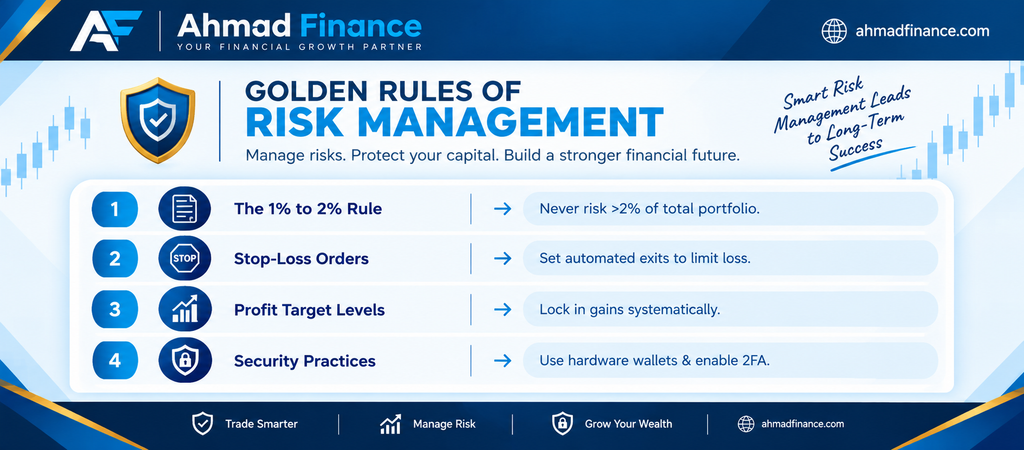
1. The 1% to 2% Rule
Don’t put more than 1% to 2% of your trading portfolio at risk on any one trade. So if your trading balance is $1,000, the most you should be willing to lose on a single position is $10 to $20. Small losses are easy to recover from. Big ones aren’t.
2. Always Set Stop-Loss Orders
A stop-loss order is an instruction you place on an exchange that sells your asset automatically once the price falls to a level you’ve chosen. If the market suddenly turns against you, the order fires on its own and caps the damage before it eats into your account.
3. Establish Clear Take-Profit Levels
Greed is one of the biggest reasons beginners fail to lock in gains. Before you enter a trade, decide on a realistic profit target using levels you can see on the chart, then set an automatic take-profit order so the decision is already made.
4. Cold Storage and Wallet Security
Exchange accounts are handy when you’re trading actively, but anything you plan to hold for the long term belongs in a self-custodial wallet, either a hardware wallet or a well-secured software one.
- Turn on two-factor authentication (2FA), and use an authenticator app instead of SMS codes.
- Never give your private seed phrase to anyone, for any reason.
Step-by-Step Execution: How to Place Your First Trade
Ready to get started? Here’s a simple workflow to follow:
- Choose a reputable crypto exchange: Pick a regulated, trustworthy platform with low fees, good liquidity, and clear security practices.
- Complete identity verification (KYC): Submit the required ID documents so your account is protected and your trading limits are unlocked.
- Fund your account: Add money by bank transfer, credit card, or a supported peer-to-peer (P2P) payment method.
- Select your target asset: While you’re learning, stick with large, proven coins such as Bitcoin or Ethereum.
- Analyze the chart: Mark the support levels, check your indicators, and work out where you’d enter and where you’d exit.
- Execute the trade: Choose your order type. A market order fills instantly, while a limit order buys only at the price you name.
- Set risk controls right away: As soon as your buy order fills, place your stop-loss and take-profit orders.
Common Mistakes Beginners Must Avoid
- FOMO (Fear of Missing Out): Jumping into a coin after it has already surged because you’re afraid of missing out. Buying at the peak of the excitement often ends in a sharp drop.
- Over-leveraging: Stay away from high leverage (borrowed money) at the start. Futures and margin trading magnify your losses just as quickly as your profits.
- Trading without a plan: Making trades because of social media buzz or hyped-up videos, without doing any analysis of your own.
- Panic selling: Dumping your coins at the very bottom of a correction instead of sticking to your long-term plan.
Conclusion
Getting good at crypto trading strategies for beginners is an ongoing process of learning, practice, and discipline. The market offers real opportunities, but you’ll only make the most of them with patience, honest analysis, and strict control over risk.
Start small. Build up your holdings in top-tier assets using proven approaches like dollar-cost averaging or swing trading, and make security a priority from day one. As you gain experience in the real market, you can sharpen your analysis and shape strategies that fit your own financial goals.
Disclaimer: Content published on Cryptobyhasnain is for informational and educational purposes only and should not be construed as financial advice. Always do your own research before making any investment decisions.