

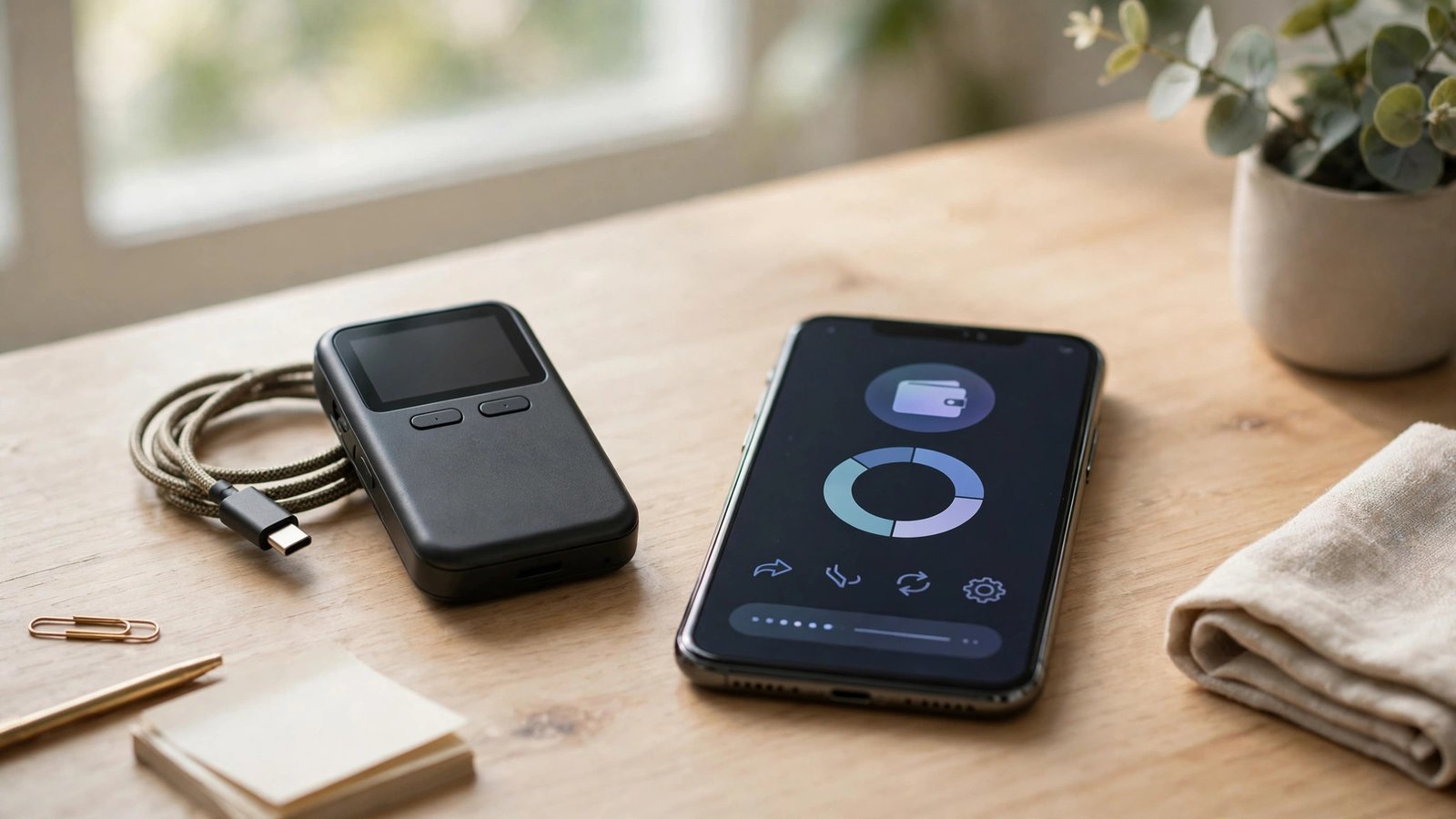
Imagine buying gold coins and then deciding where to keep them. You could carry a few in your pocket for everyday spending, or you could lock the rest in a strong safe at home. A crypto wallet works in a very similar way. If you are new to digital money, getting a clear crypto wallet explained in plain words is one of the most important first steps you can take, because the wallet you choose decides how safe your coins really are.
Here is the surprising part: a crypto wallet does not actually store coins inside it like a leather wallet stores cash. Your coins always live on the blockchain, which is like a giant public record book. The wallet stores the secret keys that prove the coins belong to you. Think of it like the key to a safety deposit box. The box stays in the bank vault, but without your key, nobody — including you — can open it. Lose the key, and the contents are gone forever. That is why understanding hot wallets and cold wallets matters so much.
What Does a Crypto Wallet Actually Do?
Every wallet holds two important pieces of information. The first is your public address, which works like an email address. You can share it freely so people can send you crypto. The second is your private key, which works like the password to that email account — except there is no “forgot password” button. Whoever knows the private key controls the coins, completely and permanently.
Most modern wallets show you this private key in the form of a seed phrase: a list of 12 or 24 simple words shown to you once when you set the wallet up. Those words are the master key to everything. A good wallet also lets you check your balance, send coins, receive coins, and connect to crypto apps, all without ever showing your secret key to anyone else.
Your keys, your coins
You will often hear the phrase “not your keys, not your coins.” It means that if a company holds your keys for you, you are trusting that company with your money, much like money in a bank. If you hold your own keys, you are in full control — but also fully responsible. Neither choice is automatically right or wrong. It depends on how much you own, how often you trade, and how confident you feel managing your own security.
Hot Wallets: Connected and Convenient
A hot wallet is any wallet that stays connected to the internet. It might be an app on your phone, a program on your computer, an extension in your web browser, or an account on a crypto exchange. Because it is online, it is fast and easy to use. Sending coins takes seconds, and connecting to a new crypto app is usually just a couple of taps.
Think of a hot wallet as the everyday wallet in your back pocket. It is perfect for small amounts and daily use, but you would never carry your life savings around in it all day. The same logic applies here: convenience comes with more exposure.
Common types of hot wallets
Mobile wallets are apps on your phone and are the most popular choice for beginners. Browser extension wallets live inside Chrome or Firefox and are popular for using web-based crypto apps. Desktop wallets are programs installed on a computer. Exchange accounts are the simplest option of all — the exchange creates and manages the wallet for you — but remember, in that case the exchange holds the keys, not you.
The risks of hot wallets
Because hot wallets are connected to the internet, they face online dangers. Malware on your phone or computer could try to steal your keys. Fake apps that look like real wallets can trick you into handing over your seed phrase. Phishing websites copy real wallet pages to steal your details. None of this means hot wallets are unsafe for everyone — millions of people use them daily — but it does mean they are best for amounts you can afford to be relaxed about, protected by strong passwords and two-factor authentication wherever possible.
Cold Wallets: Offline and Secure
A cold wallet keeps your private keys completely offline, away from the internet. The most common type is a hardware wallet: a small device that looks like a USB stick. You plug it in only when you want to approve a transaction, and your keys never leave the device. Even if your computer has a virus, the device signs transactions safely inside itself.
Using our gold example again, a cold wallet is the safe bolted to the floor at home. It is not convenient for grabbing a coin on your way out, but it is exactly where your valuable items belong. Paper wallets — literally printing your keys on paper — are an older cold storage method, but they are fragile and easy to misuse, so hardware wallets are the standard recommendation for beginners today.
The trade-offs of cold storage
Cold wallets cost money, usually the price of a nice dinner out, while hot wallets are free. They also require more care. You must keep the device safe, remember its PIN, and store your seed phrase somewhere secure, like a fireproof box — never a photo on your phone or a note in your email. If you lose both the device and the seed phrase, there is no customer service line that can rescue your coins. That responsibility is the price of true self-custody.
Hot vs Cold: A Simple Comparison
Here is the difference in everyday terms. A hot wallet is connected, free, instant, and ideal for small amounts, learning, and frequent transactions — but more exposed to online attacks. A cold wallet is offline, costs money, takes a little extra effort for each transaction, and is ideal for larger amounts you plan to hold for months or years. Most experienced holders use both: a hot wallet as their spending pocket and a cold wallet as their savings safe. That balance gives you convenience when you need it and strong protection where it counts.
How to Choose as a Beginner
Start by asking three questions. First, how much are you holding? If losing it would genuinely hurt, that amount belongs in cold storage. Second, how often do you transact? Daily users need a hot wallet for practicality. Third, how technical do you feel? If setting up a hardware device sounds stressful, begin with a reputable exchange account or mobile wallet for a small amount while you learn, and move up when you are ready. There is no shame in starting small — starting safely matters far more.
Frequently Asked Questions
Can I have both a hot wallet and a cold wallet?
Yes, and most people do. You can hold the same types of coins in several wallets at once. A common setup is a mobile hot wallet for small, everyday amounts and a hardware cold wallet for long-term savings.
What happens if I lose my seed phrase?
If you lose your seed phrase and also lose access to the wallet itself, your crypto cannot be recovered by anyone. This is why you should write the phrase on paper, store it somewhere safe and private, and never type it into websites or share it with anyone.
Is keeping crypto on an exchange the same as a wallet?
Not exactly. An exchange account is convenient, but the exchange holds the private keys, so you are trusting the company. If the exchange is hacked, frozen, or goes out of business, your access can be affected. Many beginners start on exchanges, then move larger amounts to their own wallet.
Are cold wallets completely risk-free?
No wallet is completely risk-free. Cold wallets remove most online risks, but you can still lose the device, forget your PIN, misplace your seed phrase, or buy a tampered device from an unofficial seller. Always buy hardware wallets directly from the manufacturer.
Conclusion
A wallet is simply a safe home for the keys that control your crypto. Hot wallets give you speed and convenience for everyday use, while cold wallets give you strong, offline protection for amounts that matter to you. As a beginner, start small, learn how your wallet works with a tiny amount first, guard your seed phrase like the key to your house, and upgrade your storage as your holdings and confidence grow.
Disclaimer: This article is for educational purposes only and is not financial advice. Cryptocurrency is volatile and high-risk — never invest money you cannot afford to lose.